
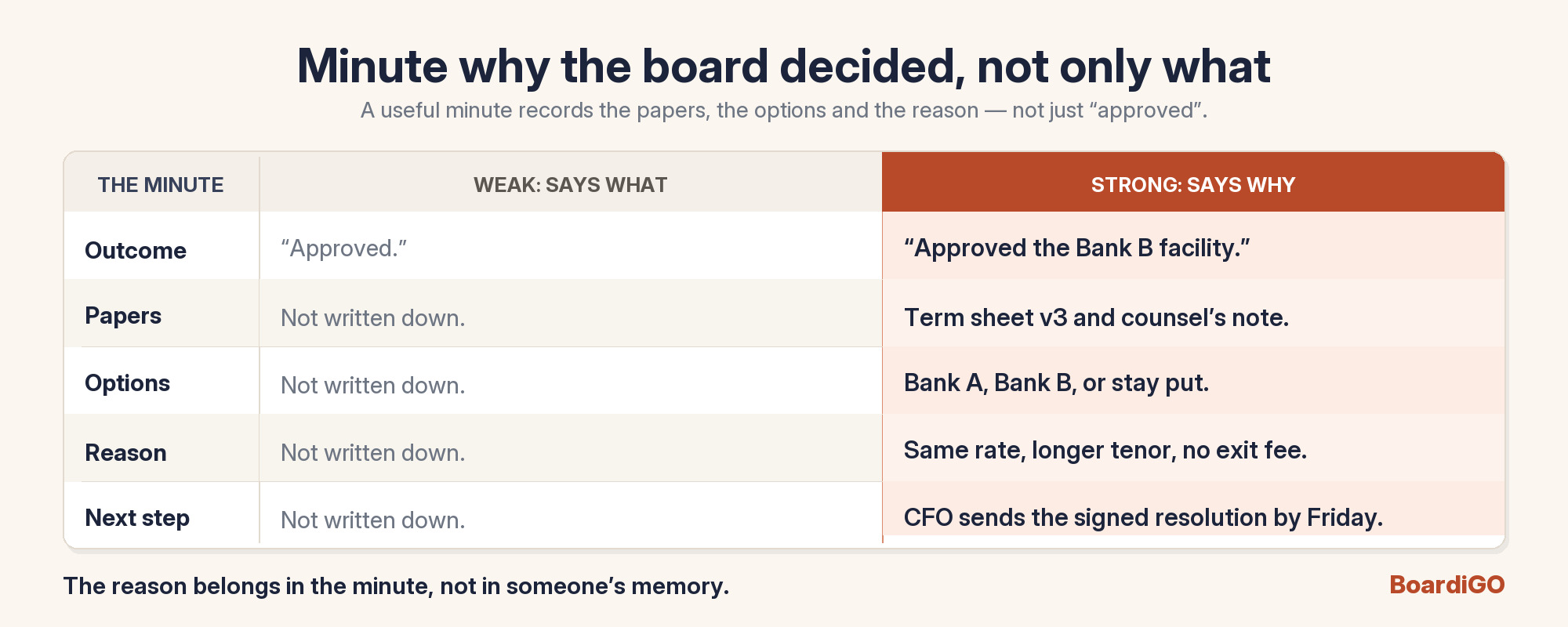
Two years after the board approved a new bank facility, an investor in diligence asks a simple question: why that bank? The minute says: “The board approved the facility with Bank B.” The director who knew the answer has left. The CFO remembers there were other offers, but not what they were.
The decision is on the record. The reason is not.
What a minute that only says “approved” leaves out
Most minutes record the outcome and stop there. That works until someone looks back:
- An investor asks why the board chose this option.
- An auditor asks what the board had in front of it when it decided.
- A new director wants to know whether an idea was already looked at and turned down.
- The board itself comes back to the decision and cannot remember what it weighed.
“Approved” answers none of these.
Four short lines that make the minute useful
You don’t need a long minute. For each real decision, add four short lines:
- The papers the board relied on, and which version.
- The options it considered, including doing nothing.
- The main reason it chose this one.
- Any conditions or next steps, with an owner.
Keep it factual and short. It is not a transcript of the debate, and it does not need to say who said what. Your statutes, the law that applies to your company or your counsel may also set what a minute must contain. Follow that first, then add the reasons.
Where BoardiGO fits
In BoardiGO, the board pack sits next to the agenda, so the papers the board read stay with the decision they supported. Every vote is recorded on the agenda item that raised it, with the result and the rule it was decided under. The minute is drafted from that live record of the meeting, then reviewed by the secretary and signed by the chair. Any follow-up becomes an action with an owner and a deadline, next to the decision that created it.
BoardiGO does not decide what the reason was. The chair and the secretary do, in the room, and the secretary writes it into the minute. BoardiGO keeps the reason, the papers and the vote together on the record.
When someone asks “why did we do that?”, the answer should already be in the minute.