
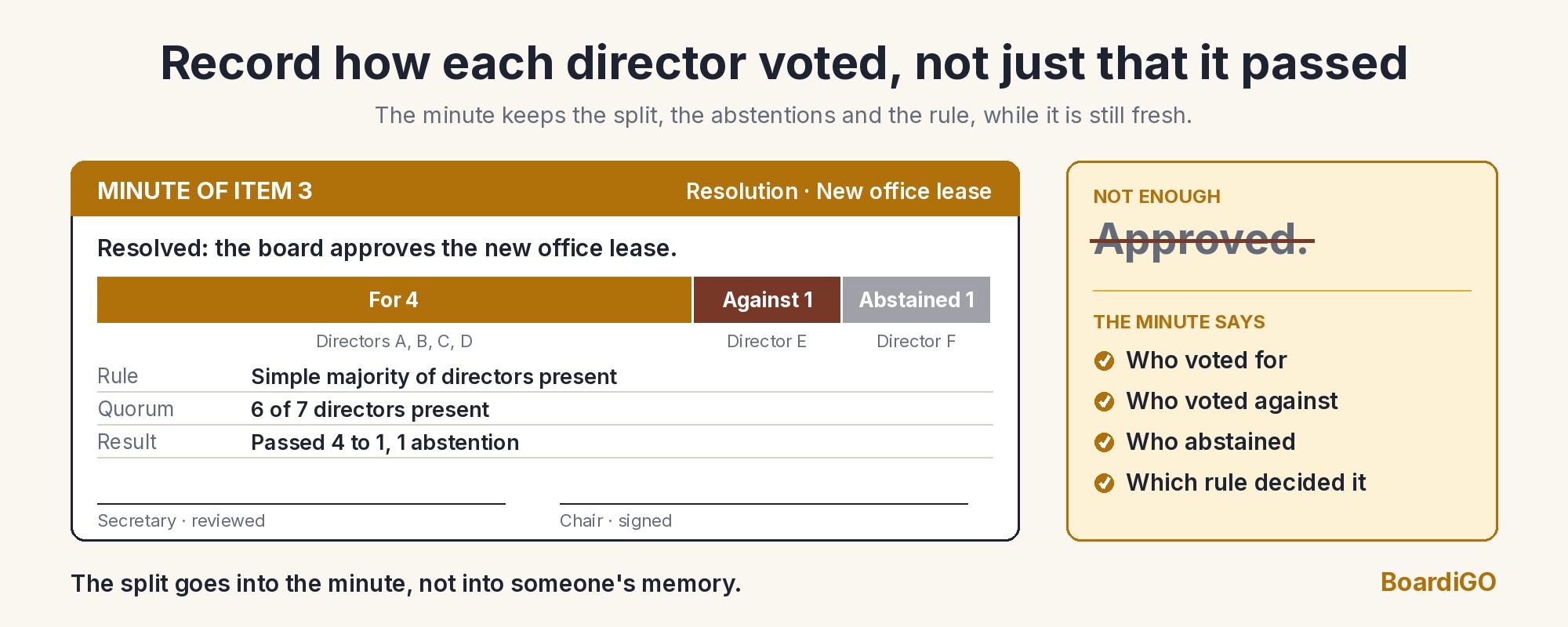
Item 3 was the new office lease. The discussion was long, one director pushed back hard, and the board voted. The minute says one word: approved.
Eight months later the lease turns out to be expensive. A new investor asks whether the board was split. The director who pushed back says she voted against. Another director remembers it as unanimous. The minute cannot settle it, because it only kept the result.
What approved leaves out
A one-word minute hides most of what the board actually did:
- Who voted for, and who voted against.
- Who abstained, and who sat out the vote.
- Which rule decided it: simple majority, a higher threshold, or unanimity.
- Whether the meeting was quorate when the vote was taken.
None of this matters on the day. All of it matters the first time someone questions the decision.
Write the vote, not the verdict
The habit is simple. For every item that asks for a decision, the minute records four things, in the same order every time:
- The resolution, in the words the board voted on.
- How each director voted: for, against or abstained.
- The rule it was decided under, and the result.
- Anyone who did not take part, and why.
A director who votes against should not have to ask for it to be noted. It should already be there. Your statutes or the law that applies to your company may set what the minute has to include. Check it once, agree it, and minute every vote the same way.
Where BoardiGO fits
In BoardiGO, every vote is recorded on the agenda item that raised it, with the result and the rule it was decided under. BoardiGO records who decided what. The minute is drafted from that live record, reviewed by the secretary and signed by the chair, so the split is written down while it is still fresh, not reconstructed from memory.
BoardiGO does not run anonymous ballots. Votes are accountable and on the record. If anonymous voting is a hard requirement for your board, tell us early.
The next time someone asks “was the board split on the lease?”, the answer should already be in the minute.