
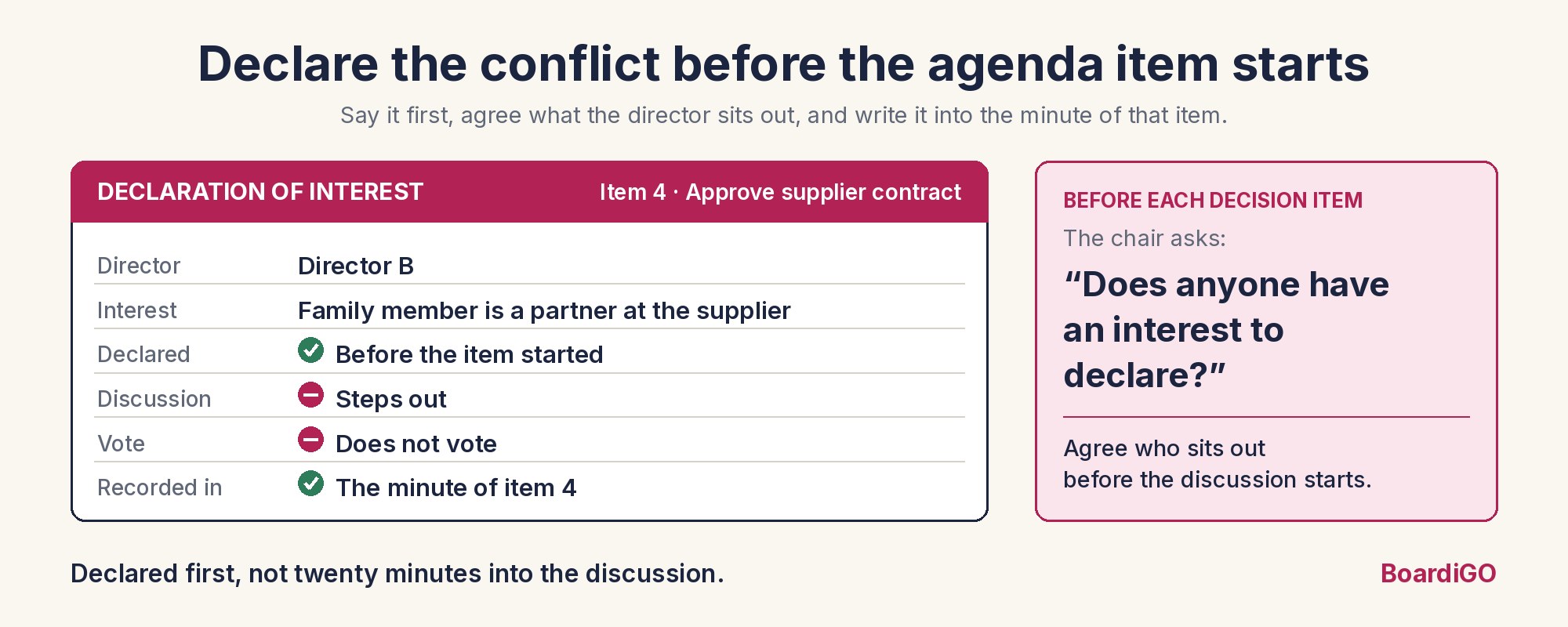
Item 4 is the new supplier contract. Twenty minutes into the discussion, one director mentions that her brother-in-law is a partner at the supplier. She did not hide it. It simply never came up until the item was already under way. Now the board has to work out whether her questions shaped the discussion, whether she should vote, and what the minute should say.
Nobody did anything wrong. The declaration just came too late.
Why late declarations hurt
A conflict of interest is rarely the problem on its own. Boards deal with them all the time. The trouble starts when it surfaces in the middle of the item:
- The director has already taken part in the discussion.
- The board has to decide on the spot whether the vote still stands.
- The minute ends up with a vague line, or no line at all.
- Months later, nobody can say who sat out which decision.
Declare first, then decide
The habit is simple: before each item that asks for a decision, the chair asks whether anyone has an interest to declare. Directors check the agenda when the pack arrives, so nobody is surprised in the room. When someone declares, the board agrees three things before the discussion starts:
- What the interest is, in one plain sentence.
- Whether the director stays for the discussion, the vote, both, or neither.
- That the declaration goes into the minute of that item, not a general note at the end.
Your statutes or the law that applies to your company may set the exact rule for who can vote. Check it once, agree it, and apply it the same way every time.
Where BoardiGO fits
In BoardiGO, the agenda goes out with the board pack, so directors can see every decision coming before the meeting. Every vote is recorded on the agenda item that raised it, with who decided what. The minute is drafted from that live record and reviewed by the secretary, who adds the declaration to the item it belongs to.
BoardiGO does not keep a full conflict-of-interest register. If you need one, tell us early. What it keeps is the decision, and who took part in it, on the record.
The next time someone asks “who voted on the supplier contract?”, the answer should already be in the minute.