
The chair asks “all in favour?” Five hands go up, two stay down, and one director on the call is not sure whether they count. Did it pass?
If nobody stated the rule before the vote, the answer depends on who is counting. And a decision that might not have passed is a decision someone can reopen.
Settle three questions before the vote
Before an item goes to a vote, the board should be able to answer:
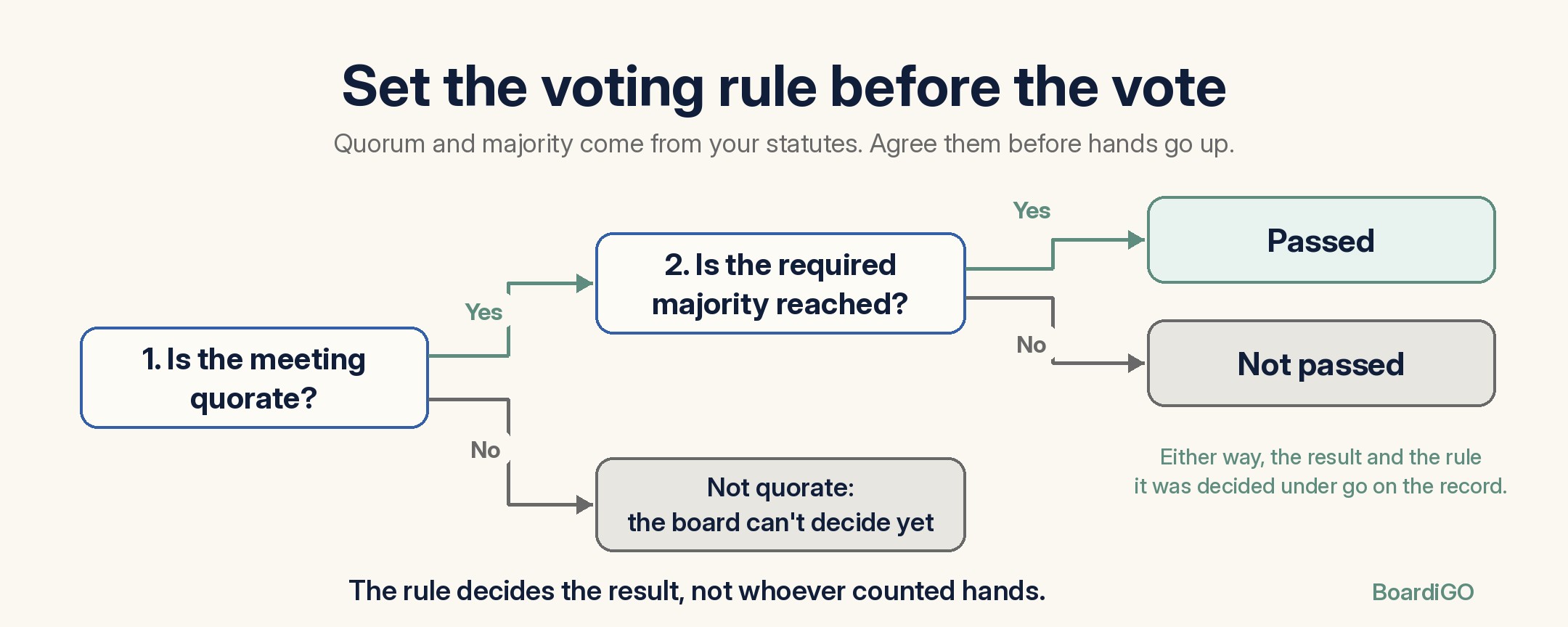
- Is the meeting quorate? How many directors must take part for the board to decide at all.
- What majority applies? A simple majority, a qualified majority or unanimity — whatever your statutes require for this kind of decision.
- Does it need more than one approval? Some decisions need a second step before they are final.
These answers come from your statutes, not from the room. Write them down once, ahead of time, so the vote is about the question and not the arithmetic.
What changes when the rule is set in advance
When the rule is known before anyone votes, the result is simply a reading of the count. Nobody argues afterwards about whether the director on the call made the quorum. The minute can state the result and the rule it was decided under. And when an investor or a lawyer later asks whether a resolution passed, the answer is on the record rather than in someone’s memory.
Where BoardiGO fits
In BoardiGO, you set the rules your statutes require — quorum thresholds, majority types, multi-step approval chains — and BoardiGO applies them when the vote happens. Every vote is recorded on the agenda item that raised it, with the result and the rule it was decided under.
BoardiGO does not decide what your statutes say. You set the rule; BoardiGO applies it when the board votes, so whether a decision passed is decided by the rule, not by whoever counted hands.
Before your next board vote, ask: could everyone in the room say, right now, what it takes for this to pass?